TROPICAL-TRIBE
There is a moment when a few houseplants become a collection. It may happen when the windowsill is full, when watering requires moving several pots, or when another plant arrives as a gift and has no obvious place to go. That moment is worth noticing. It invites a different question from the one that began the hobby: not which plant looks appealing, but how the plants already present can live well together with the people in the room.
A small collection can have considerable presence. Three distinct shapes, placed where they receive suitable conditions and can be cared for easily, may create a more convincing indoor garden than a crowded shelf of neglected specimens. The goal is to organize relationships among living plants, containers, furniture, and routine. The finished display should remain workable when you are holding a watering can rather than a camera.
Make an inventory that describes living things
Begin with the plants themselves, one at a time. Record each plant's identity as accurately as possible, its current location, container arrangement, approximate size, and any care information you trust. Photograph labels and keep them with the notes. A common nickname can be convenient at home, but a botanical name is more useful when seeking reliable guidance.
Add a plain observation rather than a judgment. Write that a plant leans toward the window, that its leaves extend beyond the shelf, or that the pot is difficult to lift. Avoid labeling it happy or unhappy without explaining what you see. Specific observations make it easier to distinguish a care question from a placement problem.
Then record your relationship with the plant. Perhaps one was a gift, another is the first you kept successfully, and a third was purchased because of a striking leaf shape. These details help when the collection needs editing. Practical decisions do not have to ignore meaning, but meaning becomes easier to honor when it is named rather than used as a vague reason to keep everything indefinitely.
Group visually without assuming identical needs
Plants can look harmonious while requiring different care. University of Florida guidance for indoor gardens stresses compatibility in light, water, soil, and nutrient requirements when plants share a growing arrangement. For a home display, keeping plants in separate appropriate containers can preserve flexibility while allowing them to be seen as a group.
Do not let visual grouping become a universal watering schedule. Label or document individual requirements and check each plant accordingly. A row of matching pots can conceal different growing media and root conditions, so the appearance of uniformity should not become an assumption about care. The display is a visual composition; the plants remain individual organisms.
Start with a location that suits the plants you intend to place there. If two plants need incompatible conditions, separate them and connect the room through color or container style instead. Repeating a muted pot color across different suitable positions can create coherence without forcing every plant into the same corner.
Give every plant a reachable place
Assess the collection while pretending it is care day. Can you inspect each pot, reach the growing surface, and move the container if needed? Do leaves prevent access to the plant behind them? Does one heavy outer pot require awkward lifting every time you need to check for collected water? These inconveniences often remain invisible in a styled photograph.
Choose stands and shelves suited to their intended loads and follow installation instructions. Account for the weight of watered containers, and consider the household's children, pets, and movement patterns. Do not create a display that relies on balancing a pot at an edge or climbing on unsuitable furniture to reach it.
Keep a practical route between the plants and the place where care happens. If you water at a sink, consider how you will carry containers without dripping across sensitive surfaces. If plants are cared for in place, use an appropriate method for protecting surfaces and managing drainage. The routine should be clear enough that another responsible person could follow it when you are away.
Compose with silhouette before adding more pots
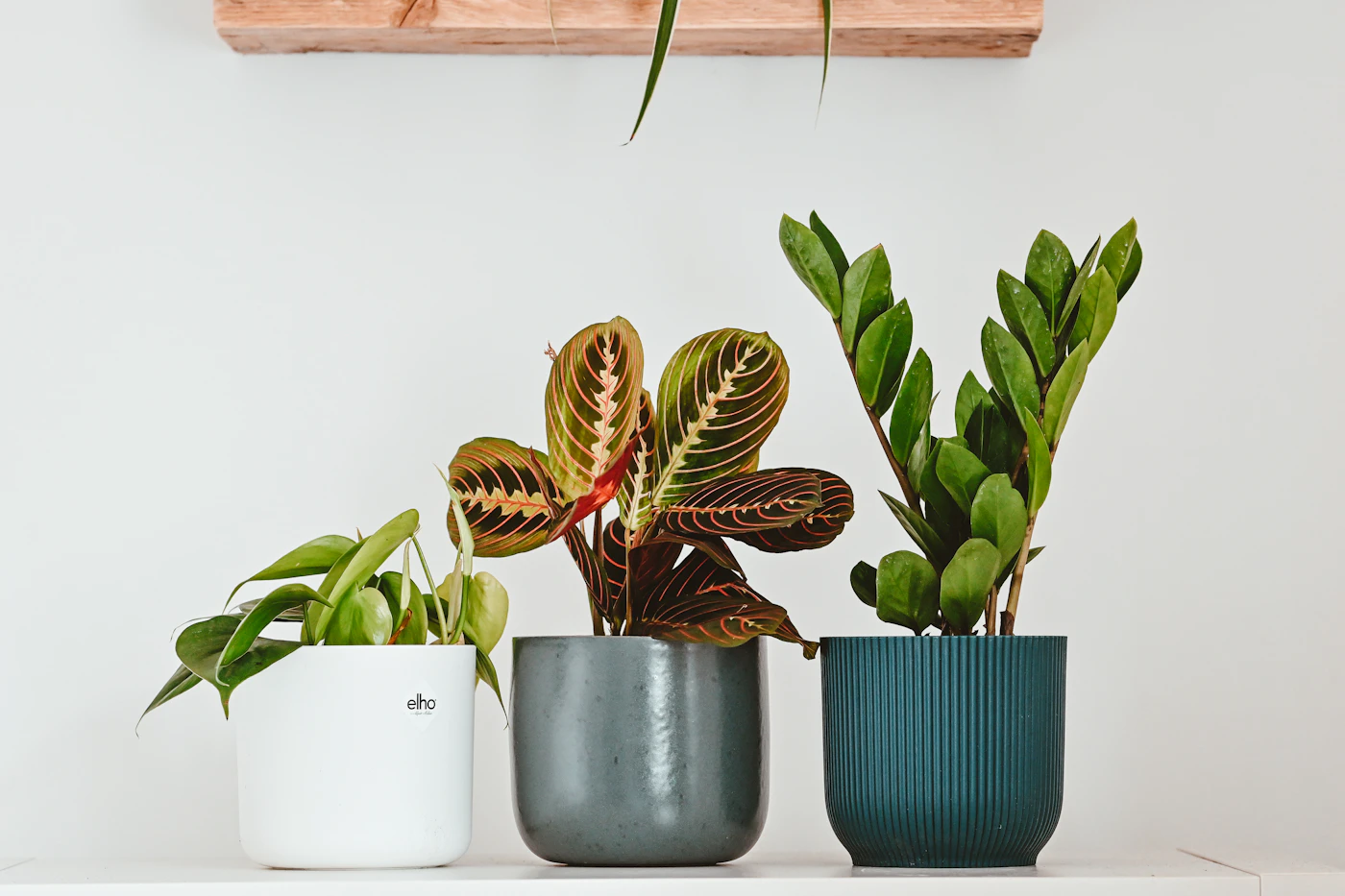
Look at the outlines of the plants from across the room. A tall upright form, a lower spreading shape, and a modest trailing plant can create variation without a large collection. Their relationship matters more than whether they all have different leaf colors. Too many competing silhouettes in a small space can make the display difficult to read.
Leave visible gaps. A patch of wall or shelf between plants gives each shape definition and keeps the collection from becoming a continuous mass. This is especially useful when foliage is already dense. Empty space is not evidence that another plant is needed; it can be part of the arrangement.
Vary height only through stable, appropriate supports and suitable placement. A plant stand can change the composition, but it should not move a plant outside its useful light or make care awkward. Start by rearranging what you own. Sometimes the best change is to lower one pot, separate two similar shapes, or remove an unnecessary decorative object from the group.
Use containers as a quiet framework
A small family of container colors can connect an otherwise varied collection. The pots do not have to match exactly. Similar warmth, finish, or shape may be enough. If the foliage provides abundant detail, quieter containers often allow it to remain the focus. If the plants have restrained forms, a meaningful pot can become a deliberate accent.
Function comes before the outer appearance. Understand how each growing container and decorative vessel work together, including access to drainage and the ability to inspect collected water. Follow plant-specific advice and the container maker's instructions. Do not hide a care problem inside an attractive cachepot because the combination looks finished from the front.
Avoid repotting every plant solely to make the display coordinate. A decorative outer container may be an option where appropriate, or the existing pot may simply remain. Horticultural needs should determine changes to the growing setup. The room can accommodate a little visual variety more easily than a plant can accommodate an unnecessary intervention made for symmetry.
The fictional collection that needed subtraction
Consider a fictional apartment with seven plants spread across a sill, a narrow shelf, and the coffee table. The owner enjoys all seven but finds care increasingly awkward. Two pots are hard to reach, a trailing stem catches on a curtain, and the coffee table plant is moved whenever someone wants to use a laptop there.
The owner starts with an inventory and location review. A qualified nursery helps clarify the plants' requirements. Four plants are reorganized into suitable accessible positions near the window, with enough separation to inspect each one. One goes to a different room with appropriate conditions. Two are offered to friends who can provide suitable care, with their identities and known care information passed along.
The collection now looks more intentional, even though it is smaller. The coffee table becomes usable again, the curtain moves freely, and care no longer requires dismantling the shelf. No dramatic new purchase creates the improvement. The change comes from acknowledging the household's capacity and giving each remaining plant a more workable place.
Build a care station that does not take over the room
Keep the supplies you actually use together: an appropriate watering vessel, surface protection, labels, a small notebook, and any tools required for your plants. Store products and tools safely according to their labels and away from children and pets. Avoid leaving a collection of partly used supplies scattered behind pots where they are difficult to inspect.
Separate routine supplies from occasional equipment. Items used frequently should be easy to reach; repotting materials can be stored elsewhere if suitable conditions allow. This reduces the temptation to turn the living area into a permanent workbench. A plant collection can belong in the room without every associated task being staged there all the time.
Choose a care location with cleanup in mind. Protect surfaces appropriately and follow guidance for disposing of plant material and used supplies. Do not assume unwanted plants or potting material can be discarded outdoors. Local disposal rules and invasive-species considerations can matter, especially when moving or reducing a collection.
Establish a review rhythm rather than a rigid ritual
A brief regular look at the collection can reveal changes before they become confusing. Check access, size, visible condition, and whether the arrangement still fits the room. Use plant-specific guidance for actual watering and other care decisions. A calendar can remind you to observe, but it should not replace attention to the individual plant and its conditions.
Take occasional photographs from the same angle. They can help you see growth and changing proportions that are difficult to notice day by day. Add a note when you move a plant, change a container, or adjust a care practice. This record is especially useful if you later consult a local extension service or knowledgeable professional about a problem.
Avoid diagnosing every imperfect leaf through a quick image search. Similar visible changes can have different causes. Gather the plant identity, recent history, and environmental information before asking for advice. The organized collection makes this easier because you can actually reach, observe, and describe each plant without disturbing several others.
Decide what qualifies a new plant for entry
Before adding another plant, identify its intended location and confirm that the location can support it. Ask how large it may become indoors, what care it requires, and whether it is suitable for the household. A plant should not arrive first and begin a competition for the remaining light afterward.
Use a waiting list if you enjoy browsing. Record the plant's name and why it interests you, then revisit the idea after a little time. You may discover that the appeal was a photograph rather than a real desire to care for that species. Waiting also allows you to learn whether the existing collection already fills your available attention.
Make gifts easier by telling friends what you can accommodate. You can appreciate a generous gesture while explaining that plant space is limited. Suggesting a book, a suitable pot, or no gift at all may be more practical. A collection should grow through informed choices rather than through the fear of appearing ungrateful.
Plan absences and changes in household life
Travel, a move, a new pet, or a change in work schedule can alter what collection size is manageable. Review the plants when those circumstances change. A setup that worked while you were home daily may need a different care plan during frequent trips. This is an ordinary adjustment, not a failure of commitment.
Prepare simple instructions for a caretaker, using plant identities and clear locations. Avoid a single vague request to water everything. Explain how to check the relevant needs and whom to contact if something seems wrong. Keep containers accessible so the caretaker is not asked to lift awkward objects or guess how a hidden drainage arrangement works.
If you need to reduce the collection, rehome responsibly where appropriate and provide accurate information. Check rules before transporting plants across jurisdictions, and never release unwanted houseplants into natural areas. The collection's value is not measured by keeping every plant forever. It is measured partly by making thoughtful decisions when your circumstances no longer match its needs.
Give an unfamiliar gift a pause before placement
When a new plant arrives unexpectedly, identify it and learn its needs before incorporating it into the main display. Ask the giver or seller for the label and care information. Follow appropriate horticultural advice for inspecting and introducing plants, especially if anything about its condition is uncertain. A temporary suitable location can be more useful than immediately finding the prettiest place among the existing pots.
This pause also gives you time to consider household suitability and future size. If the plant is not a workable match, discuss responsible rehoming instead of quietly forcing it into a space that cannot support it.
Keep the collection in proportion to the home
Stand at the room's entrance and ask whether the plants support the space or dominate every useful surface. A collection can be a focal point while leaving places for books, conversation, work, and ordinary belongings. The household should not have to negotiate around foliage to complete simple tasks.
Notice which plants you enjoy observing and which ones you mostly worry about. That distinction can guide future choices. You may discover that you prefer a few substantial plants to many small pots, or a compact shelf collection to a room-wide display. Let experience shape the collection's identity rather than a fixed idea of what a plant-filled home should look like.
The most satisfying arrangement will continue to change as plants grow and life shifts around them. Leave room for that change. A small indoor collection can feel generous when its members have appropriate conditions, the care is manageable, and the people living with it still have space to sit down and enjoy the view.
Horticultural reading for compatible groupings
University of Florida's indoor-garden guidance discusses compatibility among plants. Use it as a starting point, then consult species-specific resources and your local extension service for questions about the plants in your own collection.